Showing posts with label buddhism. Show all posts

Wednesday, September 1, 2010

Day Thirteen {Meditation Challenge}: An Invitation to Tea

To honor the close of our summer vacation, we had a flower fairy tea party at sunset last night.  We made offerings of incense, lit a candle, and set the table with a dainty porcelain tea set.  I love honoring the special moments in our lives this way.  It draws us more deeply into the present and gives us a chance to really experience whatever it is we're feeling.

Last night I was feeling a mixture of emotions -- nostalgic about the end of summer and both excited and nervous about the new school year.  While A. poured tea, I noticed my fears and worries arising.  Then I remembered one of my favorite stories of the Buddha. It's a story about being present for all of our experiences and befriending ourselves through it all.  Tara Brach tells the story in her book, Radical Acceptance, excerpted below.   

Whether you're just joining us or if you've been practicing with us through the 14 Day Meditation Challenge, I hope you'll enjoy this story.  You might even consider putting a kid-friendly spin on it and re-telling it to your kiddos.  Enjoy!

“One of my favorite stories of the Buddha shows the power of a wakeful and friendly heart. On the morning of Buddha’s enlightenment Mara, the fearsome demon who symbolizes the shadow-side of human nature, fled in defeat and disarray. In Sanskrit “Mara” means “delusion” – that craving and fear that obscure our enlightened nature.  

But it seems that he was only temporarily discouraged. Even after the Buddha had embarked on his teaching career and become a revered figure throughout India, Mara continued to make unexpected appearances. Instead of driving him away, however, the Buddha would calmly acknowledge the demon’s presence saying, “I see you, Mara.”

He would then invite him for tea and serve him as an honored guest.  Offering Mara a cushion so that he could sit comfortably, the Buddha would fill two earthen cups with tea and place them on a low table between them. Mara would stay for awhile and then go, but throughout, the Buddha remained free and undisturbed.

You see, when Mara visits us in the form of troubling emotions or fearsome stories, we can say, “I see you Mara,” and clearly recognize the craving and fear that persists in each human heart. The objective is to see what is true and to hold what is seen with kindness. Our habit of being a fair-weather friend to ourselves – of pushing away or ignoring whatever darkness we can – is deeply entrenched…. We truly befriend ourselves when, rather than resisting our experience, we open our hearts and willingly invite Mara to tea.”

For more from Tara Brach including tips on meditation and Common Issues for Meditators, visit her website at: http://www.tarabrach.com

Tuesday, August 31, 2010

Day Twelve {Meditation Challenge}: Gratitude and Joy

Gratitude & Joy
It's day twelve and I have to say that I've really enjoyed sharing thoughts about meditation and mindfulness here at Om School.  Coming to this place each day reminds of the gifts in my life for which I am grateful... and that gives me joy! 

Gratitude and joy are actually closely related.  What follows is an excerpt from The Wise Heart by Jack Kornfield.  It's a guided meditaiton that could easily be adapted to share with your kids.  Enjoy!


A Meditation on Gratitude and Joy
"Let yourself sit quietly and at ease. Allow your body to be relaxed and open, your breath natural, your heart easy. Begin the practice of gratitude by feeling how year after year you have cared for your own life. Now let yourself begin to acknowledge all that has supported you in this care:

With gratitude I remember the people, animals, plants, insects, creatures of the sky and sea, air and water, fire and earth, all whose joyful exertion blesses my life every day.  With gratitude I remember the care and labor of a thousand generations if elders and ancestors who came before me. 

I offer my gratitude for the safety and well-being I have been given.
I offer my gratitude for the blessings of this earth I have been given.
I offer my gratitude for the measure of health I have been given.
I offer my gratitude for the family and friends I have been given.
I offer my gratitude for the community I have been given.
I offer my gratitude for the teachings and lessons I have been given.
I offer my gratitude for the life I have been given.


Just as we are grateful for our blessings, so we can be grateful for the blessings of others.  Now shift your practice to the cultivation of joy. Continue to breathe gently. Bring to mind someone you care about, someone it is easy to rejoice for. Picture them and feel the natural joy you have for their well-being, happiness, and success. With each breath, offer them your grateful, heartfelt wishes:

May you be joyful.
May your happiness increase.
May you not be separated from great happiness.
May your good fortune and the causes of your joy and happiness increase.


Sense the sympathetic joy and caring in each phrase. When you feel some degree of natural gratitude for the joy and well-being of this loved one, extend this practice to another person you care about. Recite the same simple phrases that express your heart's intention.

Then gradually open the meditation to other loved ones and benefactors. After the joy for them grows strong, turn back to include yourself. Let the feelings of joy more fully fill your body and mind. Continue repeating the intentions of joy over and over, through whatever resistances and difficulties arise, until you feel stabilized in joy. Next begin to systematically include the categories of neutral people, then difficult people and even enemies until you extend sympathetic joy to all beings everywhere, young and old, near and far.

Practice dwelling in joy until the deliberate effort of practice drops away and the
intentions of joy blend into the natural joy of your own wise heart."

For more from Jack Kornfield including a Walking Meditation, visit his website at: http://jackkornfield.org/home.php


Tuesday, August 24, 2010

Day Five {Meditation Challenge}: Being Present

For today's inspiration, I'm sharing the twelve minute dharma talk that I listened to this morning.  It's about being present -- being attentive and mindful to what's happening in the present moment.   Gil Fronsdal is a leading American Buddhist teacher; however, you certainly don't have to be Buddhist to enjoy this talk!


Being Present from Insight Meditation Center on Vimeo.

Gil has practiced Zen and Vipassana since 1975 and has a Ph.D. in Buddhist Studies from Stanford. He has trained in both the Japanese Soto Zen tradition and the Insight Meditation lineage of Theravada Buddhism of Southeast Asia. Gil was trained as a Vipassana teacher by Jack Kornfield and is part of the Vipassana teachers' collective at Spirit Rock Meditation Center. He was ordained as a Soto Zen priest at the San Francisco Zen Center in 1982, and in 1995 he received Dharma Transmission from Mel Weitsman, the abbot of the Berkeley Zen Center. He has been the primary teacher for the Insight Meditation Center in Redwood City, California since 1990. He is a husband and father of two boys.

Thursday, August 19, 2010

Retreat Within: 14 Day Meditation Challenge

The Inn at Schoolhouse Creek, Mendocino, CA

A few weeks ago, I had the honor of retreating with some lovely mamas to the Mendocino Coast.  This was this first in what we hope to be an annual woman's retreat.  

I came home feeling rejuvenated, relaxed, and renewed.  In the weeks that followed, I was inspired to get back into my yoga practice, succeed at a seven day raw-food cleanse, and re-commit to my meditation practice.

Most of all, I was able to carry the balance I re-claimed at our retreat into my daily life.  While I wish I could live by the sand, sea and botanical gardens, I realize that these things are just a backdrop.  The scenery that truly matters is within our own minds. Retreats and spiritual pilgrimages (think Eat, Pray, Love) are wonderful ways to connect with ourselves; however, tending to our inner-garden is something that we can do everyday -- right here at home.  

Mendocino Coast Botanical Gardens


In her poem, Risk, Anaïs Nin writes, "And then the day came, when the risk to remain tight in a bud was more painful than the risk it took to Blossom."  I think starting a meditation practice is a lot like this.  Each moment is a new chance to blossom.

It's been twenty-six days since I re-committed to my meditation practice. Two more weeks will make it forty days (an important number for Buddhists and Christians).  I've been sitting for at least thirty minutes every morning and haven't missed a day.  I feel grounded and balanced and grateful for the mamas who helped me get back to this place.  What's more, I've rediscovered that  "retreat" is a state of mind.  Each time we sit on our pillow, each time we connect with our breath, and each time we pause before we react, we take a little spiritual retreat -- we give ourselves a chance to rejuvenate and renew.

I'd like to invite you to join me on my home stretch to forty days by making a pledge to sit for the next fourteen days.  In the days that follow, I'll post instructions, tips, links, and other goodies to help you get started with a sitting practice.  

Please leave a comment here or send me an email at mettamama [at] yahoo [dot] com if you'd like to join the challenge.

[photo credits: Heather Sewell Rush & Karyl Averill]

Tuesday, August 17, 2010

Morning Ritual: Five Yogic Habits for a Stress-Free Day

Sleepy Kid in the Morning Sunbeams
I am a big advocate of peaceful mornings.  When we start our day with peace, we create an opportunity for a stress-free day.  Here are five yogic habits that might just help you create a peaceful morning rhythm.  

1.)  Rise and shine.  Begin your day with the cool earth-energy that lingers before daybreak. Savor this stillness.  Prepare to be happy and shine.

2.)  Take it slow. Instead of hitting the floor running, take a few minutes to wake up.  Sit up, take a few deep breaths, and set an intention for a peaceful day.  Consider saying a verse like this ancient Indian mantra: "On the tip of my fingers is prosperity and abundance (goddess Lakshmi); in the middle of my hand is eloquence and learning (goddess Saraswati); at the base of my hand is divine power (goddess Gauri).  In the morning, a vision of energy in my hands." 

3.)  Cleanse.  Instead of racing (or schlepping) out to the coffee maker, consider the advice of ancient yogis, step into the bathroom, and say goodbye to yesterday.  Empty your bowels, brush, floss, and scrape that fuzzy tongue.  Ayurveda interprets tongue-fuzz as a sign of undigested toxins lurking in the digestive tract.  Unless we scrape, it's reabsorbed while eating or drinking.  Next, it's time for a cool shower.  Too much steam makes us sleepy -- a cool shower wakes up the body.

4.) Meditate.  Oodles of evidence now exists in support of the benefits of meditation.  Some of the health benefits include stress reduction, better sleep, lower blood pressure, an increased sense of well-being, and increased neuroplasticity.  To begin, borrow a pillow from your couch, put your tush on the cushion, and breathe.  It's that simple.  Just sit for a few minutes each morning and focus on your breath instead of your thoughts.  For instruction on mindfulness meditation, click here.  For instruction on Zen practice, click here.

5.) Step Outside.  Take a few minutes each morning to connect with nature.  Step into your garden or onto your patio and absorb some of the cool, new day.  Stand in Mountain Pose for a few minutes with your feet rooting down into the earth.  Notice the color of the sunlight and the sensation of morning air in your lungs.  Feel the freshness of the hour.  Instead of plopping them in front of the tube, invite your kids to join you outside.  Take just one breath together, smile, then quietly say, “Good morning, world!” Take this stillness into your day.

A few small changes in your routine might just make a big difference.  Beginning your day with peace in your heart is certainly a step in the right direction.  As Patanjali, compiler of the Yoga Sutras, writes, “Peace can be reached through meditation on the knowledge which dreams give.  Peace can also be reached through concentration upon that which is dearest to the heart.”

Mindfulness Meditation for Kids & Families

When we practice paying attention on purpose to the unfolding of our lives, we see the ordinary miracles that give our lives meaning.  

Cultivating this mindful awareness promotes a deeper and more enduring sense of well-being found though simply being with whatever is happening in the present moment, with a recognition that it will pass and be replaced by a new experience in the next moment. (1) 


With mindfulness, we can feel our connection to the world, see that the light always follows the dark, and know that happiness is available right here in our everyday lives.  When we encourage our children to develop moment-to-moment awareness, we give them the opportunity to understand the greater context from which their lives emerge.We give them the opportunity to discover happiness moment by moment and day by day.

But how do we begin cultivating moment-to-moment awareness?  One tried and true method is through a daily meditation practice.  By sitting for just a few minutes each day, we can discipline our mind into becoming more connected to the present moment -- and less prone to becoming lost in worry and planning. 

Here are a few tips to get you and your kids started:
  • Find a quiet corner in your house and sit comfortably on the floor.  Consider placing a couch cushion on the floor and sitting cross legged there.
  • Relax your eyes.  Focus downward and a few feet in front of you.
  • Focus your attention on your breath and breath normally.  Feel your breath in your nostrils as you inhale and exhale.
  • Notice what you feel.  Becoming aware of your experience (whatever that is) is the most important thing.  Hold yourself in compassion with non-judgmental acceptance.
  • As your thoughts arise, try watching them rather than letting your mind drift away with them.  When you realize that your mind has wandered, bring your focus back to your breath again. 
The rule of thumb is that kids can generally sit for up to as many minutes as they are old.  Still, go with what works for you and your family.  For adults, try starting with just five or ten minutes.  

With practice, you'll be able to sit longer and bring the focused, relaxed attention cultivated on your pillow into your daily life.

(1) Kabat-Zinn 2003; Wallace and Shapiro 2006

Tuesday, August 10, 2010

A Wise Heart

We've been infusing our studies with the dharma since preschool.  Along with trips to Green Gulch Farm Zen Center and Spirit Rock Meditation Center we incorporate gathas, mantras, mindfulness exercises, the Eightfold path, the Brahma Viharas, and the Pāramitās into our studies.  We've worked out a pretty elaborate system over the years and it's been a real joy.  A. will be six on Thursday and she seems to truly enjoy this aspect of our home studies.  

At present, I'm writing a curriculum (based on our home studies) that follows the changing seasons and invites parents to engage in their child's inner-world.  Each month, we look at a virtue (compassion, loving-kindness, joy in others, equanimity, patience, generosity, wisdom, etc) and explore how nature is the best teacher.  I thought I'd share a bit of our routine here for all of you who are considering homeschooling or wondering how to incorporate your spiritual path into your daily schedule.

We start each day by lighting a candle and making an offering of incense in the kitchen. Then we listen to mantras and cook together.  A. sets the table and we eat quietly to set a focused tone for the school-day.  She either draws or plays while I clean up -- but not with anything noisy, digital, or electric.  I encourage stillness in the morning and have found that the less riled up she is before we start our day, the better.

Next it's Circle Time.  We sit on our zafus facing one another in the classroom and start our day with this gatha:

We are the leaves of one tree
We are the waves of one sea
The time has come for us to live as one

After the morning verse, I say a cheery little prayer such as, "Mother Nature, Universe, gods and goddesses, buddhas and bodhisatvas, ancestors, and fairies -- we're calling on all of the energies of the earth to be present in our classroom today... help our hearts grow wise so that we may know peace within and create peace here on the earth.  Blessed be, so be it, and let it be so!"

Then I say, "let us enjoy breathing together," ring our little gong, and we sit for a few breaths to focus and really arrive in the classroom.  I encourage A. to listen to all of the sounds, feel her breath in her nostrils, and notice all of her feelings.   Sometimes we'll lay on our backs with stones on our bellies and watch the stones rise and fall with our breath.  Other mornings, I ask her to listen to the gong and raise her hand when the sound has completely vanished.

Next, I invite A. to go to her "Creative Infinity"  -- the creative center of our being where the universe comes from.  Here, we look for a virtue in the form of an animal totem to "bring back" to the classroom and keep with us all day.  Some of A.'s favorites are the Cheetah of Loving-kindness and the Deer of Compassion.

After Creative Infinity comes Sharing Time.  We pass a basket of sticks and stones between us - each selecting one as a "talking stick" or a "stillness stone."  I invite A. to share anything she wants -- a difficult feeling, a story, or a favorite toy.  I usually share the calender and then use the rest of my share to introduce, review, or expand on a dharma or mindfulness unit.

Then it's time for the Main Lesson.  For Kindergarten we alternated between Language Arts and Math and I usually used an archetypal story to introduce new letters, words, phonics, numbers, or math concepts (i.e. King Plus and Queen Minus).  After drawing the story in her Main Lesson Book, singing the spelling of new words, or marching out the math facts, it's time for a little movement.

One of our favorites is a chant that we've added asanas (yoga poses) to:

Earth my body (mountain pose)
Water my blood (five pointed star pose)
Air my breath (standing prayer/pranam)
And fire my spirit (clap hands and wave them above your head)

Then it's lunch time.  While I prepare our food, she has playtime inside.  We usually set the table and recently started a new ritual of setting our food down by the kitchen alter for blessings before we eat (that's Saraswati, the goddess of creativity and learning, in the picture frame).  

Here's a great little gatha to make lunch more mindful:

Earth who gives to us this food
Sun who makes it ripe and good
Dear Earth, dear Sun
By you we live,
Our loving thanks
To you we give.

After lunch it's outside time.  I try to incorporate some Earth Science into our outside time but sometimes A. just plays.  After an hour or so, it's back in for an afternoon lesson.  I use this time for art, music, dance, yoga, science, or social studies. We alternate through these subjects throughout the week and I'm always amazed at how they integrate so naturally with the morning lesson.

We end each school day with a verse that I found in the Oak Meadow Kindergarten Syllabus.  I've expanded it and added yoga poses:

I can be as small as a small, small seed (child's pose)
I can be as tall as a tall, tall tree (tree pose)
As strong as a mountain (mountain pose)
As brave as can be (warrior III)
Because I'm a Goddess (goddess pose)
Can't you see!

One of the greatest things about educating at home is making it personal.  Incorporating our spiritual path into our studies with gathas, mantras, and mindfulness exercises has helped us strengthen our connection with one another (and with the earth) and deepened our awareness about the larger context from which our lives emerge.  What's more, this holistic method of incorporating core subjects with our spiritual path sets a framework for keeping our minds and hearts integrated.  I believe this is a path to cultivating more than intellect... it is a path to a wise heart.  

Sunday, August 8, 2010

Finding the Feminine

I was chatting with a dear friend recently, when she mentioned something about her personal deity, Artemis.  We follow similar paths and see the earth herself as a living, sacred, manifestation; however, I'm more of a pantheist and she's more of a polytheistWe don't squabble over the details though.  Instead we embrace what we share.

I had all but forgotten that she had a personal deity and my initial reaction was something like a five year old in a toy store, "I want a personal deity too!"

She went on to tell me about the process of discovering the goddess who would be her guide and the gratitude she holds in her heart now that she's found her.  In the days that followed, I decided to keep my heart open to the notion of discovering my own personal deity.  What mama doesn't need a little guidance from the divine feminine?  

To me, gods and goddesses are states of consciousness that we are all capable of becoming.  They are archetypes telling the story of the cosmic drama that plays out in our lives again and again.  They exist within us and beyond us as energies upon which we can call to be present in our hearts, in our minds, and in our lives.  They are sacred because there is nothing that is not sacred.  Every element of nature, every vibration, every thought is sacred.  Every beam of sun and each blade of grass is a sacred manifestation. 

In the days that followed our conversation, I kept my eyes open for signs of goddesses making themselves known to me.  I opened this month's Yoga Journal and found a mantra to the goddess of abundance and prosperity, Lakshmi.  Lakshmi is one of my favorite Vedic goddesses and I've actually been using her mantra all year.  Could she be my personal deity?  No, I don't think so... but I'm still calling on her just the same.

Then I thought of an article, Mothers of Liberation, that I'd recently found at Tricycle.  Here, Miranda Shaw explores "some of the many powers, symbols, and stories of the often overlooked and misunderstood [Buddhist] pantheon."  I discovered Vasudhara, Hariti, and Vajrayogini -- a divine yogini, compassionate, all-knowing, and supremely blissful. 


Could Vajrayogini be my personal deity?  Maybe.  She's my kind of goddess.  Still, I decided to keep my heart and mind open to the process.  I remembered Prajnaparamita, the Buddhist Sophia and compassionate mother of bodhi.  I remembered Prithvi, the Earth Goddess who rose up to witness Buddha attaining enlightenment under the bodhi tree.  Could Prithvi be my personal deity?  I love this idea because nature is the teacher I look to most. 

Later that night, I found myself on Etsy searching handmade items with the keyword, "goddess."  Amongst other pretty things, a silver necklace jumped out at me.  Taking a closer look, I realized it is an exact replica of the necklace I wear nearly every day -- a gift from my mother-in-law who described it as a Buddha.  Yet here, in an extreme close up view, I saw something that could mean only one thing -- breasts!  The necklace I've been wearing is not the Buddha... it is a buddha -- and a female buddha at that!

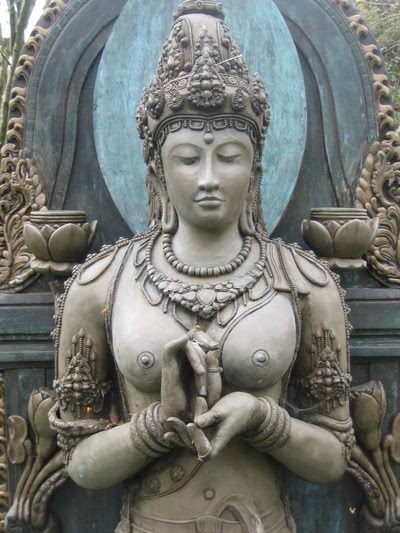
Over the next few days I searched though images and symbols on my bookshelves and on the internet.  The female buddha I've been wearing is the goddess Tara.  Tara is the mother of liberation, a bodhisattva, and in the Buddhist tradition, "Tara is actually much greater than a goddess -- she is a female Buddha, an enlightened one who has attained the highest wisdom, capability and compassion. . . one who can take human form and who remains in oneness with every living thing." [from: http://www.goddessgift.com/goddess-myths/goddess_tara_white.htm] 

As I told this story to my daughter, I remembered one of our favorite books, There Is a Flower at the Tip of My Nose Smelling Me by Alice Walker.  As it turned out, this entire time, there has been a goddess around my neck wearing me.

That's how it always is, I think.  Like in the famous poem, Footprints in the Sand by Mary Stevenson, we may not know it, we may be unconscious of it, but the goddess is always wearing us -- is always carrying us.  We are her, every bone in our body, every hair on our head, each flower, each tree, each beat of our heart, each breath -- all expressions of something sacred... all forms born from the creative energy of Mother Earth.  

I've taken this discovery back to my zafu and each morning I feel myself dissolving back into her.  She is Tara, she is Prithvi, she is Vajrayogini.  She's Mary and Artemis and Ostara too.  She is me and she is you.  She is our daughters and she is the very earth upon which we step.   

I'm still keeping my heart open to discovering an aspect of her to be my guide.  I don't want to be too hasty; although, Tara does seem like the obvious option.  More importantly, I'm remembering that to walk on the earth is to press our feet against the life-giving goddess herself.  This is why we must live skillfully and practice peace in every step.  All life is interdependent and flowing from the same source, rising and falling, constantly becoming.  Each of us is one element of a greater whole and beneath our stories and our habitual reactions exists a quiet observer dissolving back into the luminous nature of the One.

Wednesday, July 21, 2010

The Art of Non-Doing

Sometimes the best thing we can do for ourselves and for those we love is put down the to-do list and let go a little.  For many of us, the results-driven world makes that a difficult task.  One place I can usually cultivate a little mindful non-doing is in the tub.  The bubbles, the warmth, the calm of the water all have a way of restoring balance.  Yesterday's art project taught me that we don't even need to get our whole body in the tub to reap the benefits.  

We began with an afternoon walk and collected stones that were round, semi-flat, and stacked easily.  We brought the stones home, washed them, and then I filled the tub with warm, soapy water.  The girls wrapped their stones tightly with wool, then dipped them in the bubbly tub.  When wet, the wool shrinks around the stones.  The process of dipping, squeezing, and swirling the wool-covered stones in warm soapy water might calm even the most cantankerous kid.  It didn't take long before the girls were immersed fully in the moment.  Anything can be an exercise in mindfulness.  

We started with solid colors.  Then we went back and added little wisps of additional color.  I reminded the girls that this project was about the process more than it was about the end result.  As they worked, they learned that they couldn't force the wool to take the shape they wanted nor could they try to create too specific a design with the colors.  The best results came from letting go and allowing the result to manifest in its own time.  This is the art of non-doing.  When we let go of our attachment to the results, we are free to enjoy the process.

As Jon Kabat-Zinn writes in, Wherever You Go, There You Are: Mindfulness Meditation in Everyday Life, "Non-doing doesn't have to be threatening to people who feel they always have to get things done.  They might find they get even more "done," and done better, by practicing non-doing."  

Too often, we sacrifice the joy of this moment for some distant objective.  We are already half way into the next moment before this moment ends.  Yet, enjoying our life requires that we are present for it.  Our striving, our constant doing, stands between us and our joy.  Non-doing may be a lost art in today's world; nevertheless, it's an art this home-educator intends to keep in the classroom.


Tuesday, June 1, 2010

Wisdom Teachings in the Internet Age


The first ever Wisdom 2.0 conference, held April 30th-May 2nd in Silicon Valley, brought together staff from Google, Twitter, Facebook and other technology companies, along with Zen teachers and neuroscientists to explore living with wisdom in our technology age.
The list of speakers is here.  Be sure to sign up for their e-newsletter, join their Facebook page, or follow them on Twitter to learn about more Wisdom 2.0 events.

In this thought provoking panel discussion, Malika Chopra (Intent.com), Alana Kornfeld (Huffington Post Living), Susan Kaiser Greenland (The Mindful Child and Mindfulness Together), Mary Ann Brusset (Spirituality & Practice.com), and moderator by Tami Simon (Sounds True) discuss how can we use the tools that are now available to us in the twenty-first century for maximum raising of consciousness and responsible dissemination of the wisdom teachings.

It's well worth the hour to watch through the end where the panel discusses the challenges and opportunities that online communities face in creating meaningful experiences and how the wisdom and light discovered online might translate into our three-dimensional lives.
Related Posts with Thumbnails