Showing posts with label pratītyasamutpāda. Show all posts

Sunday, August 8, 2010

Finding the Feminine

I was chatting with a dear friend recently, when she mentioned something about her personal deity, Artemis.  We follow similar paths and see the earth herself as a living, sacred, manifestation; however, I'm more of a pantheist and she's more of a polytheist.  We don't squabble over the details though.  Instead we embrace what we share.

I had all but forgotten that she had a personal deity and my initial reaction was something like a five year old in a toy store, "I want a personal deity too!"

She went on to tell me about the process of discovering the goddess who would be her guide and the gratitude she holds in her heart now that she's found her.  In the days that followed, I decided to keep my heart open to the notion of discovering my own personal deity.  What mama doesn't need a little guidance from the divine feminine?  

To me, gods and goddesses are states of consciousness that we are all capable of becoming.  They are archetypes telling the story of the cosmic drama that plays out in our lives again and again.  They exist within us and beyond us as energies upon which we can call to be present in our hearts, in our minds, and in our lives.  They are sacred because there is nothing that is not sacred.  Every element of nature, every vibration, every thought is sacred.  Every beam of sun and each blade of grass is a sacred manifestation. 

In the days that followed our conversation, I kept my eyes open for signs of goddesses making themselves known to me.  I opened this month's Yoga Journal and found a mantra to the goddess of abundance and prosperity, Lakshmi.  Lakshmi is one of my favorite Vedic goddesses and I've actually been using her mantra all year.  Could she be my personal deity?  No, I don't think so... but I'm still calling on her just the same.

Then I thought of an article, Mothers of Liberation, that I'd recently found at Tricycle.  Here, Miranda Shaw explores "some of the many powers, symbols, and stories of the often overlooked and misunderstood [Buddhist] pantheon."  I discovered Vasudhara, Hariti, and Vajrayogini -- a divine yogini, compassionate, all-knowing, and supremely blissful. 
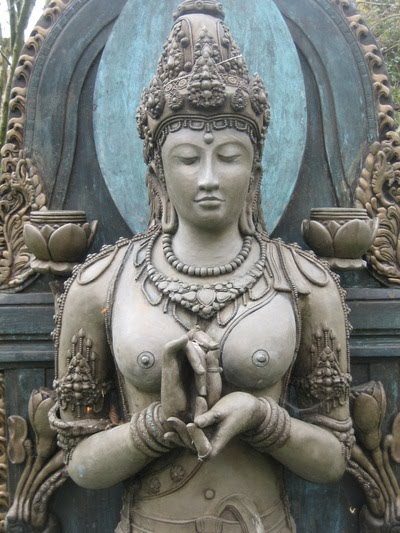

Could Vajrayogini be my personal deity?  Maybe.  She's my kind of goddess.  Still, I decided to keep my heart and mind open to the process.  I remembered Prajnaparamita, the Buddhist Sophia and compassionate mother of bodhi.  I remembered Prithvi, the Earth Goddess who rose up to witness Buddha attaining enlightenment under the bodhi tree.  Could Prithvi be my personal deity?  I love this idea because nature is the teacher I look to most. 

Later that night, I found myself on Etsy searching handmade items with the keyword, "goddess."  Amongst other pretty things, a silver necklace jumped out at me.  Taking a closer look, I realized it is an exact replica of the necklace I wear nearly every day -- a gift from my mother-in-law who described it as a Buddha.  Yet here, in an extreme close up view, I saw something that could mean only one thing -- breasts!  The necklace I've been wearing is not the Buddha... it is a buddha -- and a female buddha at that!

Over the next few days I searched though images and symbols on my bookshelves and on the internet.  The female buddha I've been wearing is the goddess Tara.  Tara is the mother of liberation, a bodhisattva, and in the Buddhist tradition, "Tara is actually much greater than a goddess -- she is a female Buddha, an enlightened one who has attained the highest wisdom, capability and compassion. . . one who can take human form and who remains in oneness with every living thing." [from: http://www.goddessgift.com/goddess-myths/goddess_tara_white.htm] 

As I told this story to my daughter, I remembered one of our favorite books, There Is a Flower at the Tip of My Nose Smelling Me by Alice Walker.  As it turned out, this entire time, there has been a goddess around my neck wearing me.

That's how it always is, I think.  Like in the famous poem, Footprints in the Sand by Mary Stevenson, we may not know it, we may be unconscious of it, but the goddess is always wearing us -- is always carrying us.  We are her, every bone in our body, every hair on our head, each flower, each tree, each beat of our heart, each breath -- all expressions of something sacred... all forms born from the creative energy of Mother Earth.  

I've taken this discovery back to my zafu and each morning I feel myself dissolving back into her.  She is Tara, she is Prithvi, she is Vajrayogini.  She's Mary and Artemis and Ostara too.  She is me and she is you.  She is our daughters and she is the very earth upon which we step.   

I'm still keeping my heart open to discovering an aspect of her to be my guide.  I don't want to be too hasty; although, Tara does seem like the obvious option.  More importantly, I'm remembering that to walk on the earth is to press our feet against the life-giving goddess herself.  This is why we must live skillfully and practice peace in every step.  All life is interdependent and flowing from the same source, rising and falling, constantly becoming.  Each of us is one element of a greater whole and beneath our stories and our habitual reactions exists a quiet observer dissolving back into the luminous nature of the One.

Sunday, April 25, 2010

The Earth in Us

Our Earth Week began with a day-trip to the ocean on the Thursday before Earth Day.  In the days prior, my morning meditation had been infused with a new sense of devotion, of love for the feminine, life giving, creative energies of Earth.  At the same time, a dear friend from out-of-state came for a visit, and we met at The Ren Brown Collection Gallery in Bodega Bay for Mayumi Oda's Feminine Buddhas exhibit.  It wasn't until we returned home that night that I realized the Sanskrit word for goddess is "devi" and it was probably no coincidence that I'd been feeling an opening in my heart, a sense of dev-otion to the feminine, leading up to our trip to the ocean.  

Friday was a beautiful morning so we hopped in the golf cart and headed out for breakfast.  Along the way, we noticed that the water at the lake was perfectly still; bright and blue glowing glass.  We pulled into the marina to watch the sky reflecting on the water.  Just then, six goslings came waddling to the edge of the lake with mama and papa close by their sides.

The morning was so still, so calm, that we came back and enjoyed breakfast picnic-style by the water.  By then the goslings had gone so we set up camp at a nearby lakeside park.  After breakfast, it was time for a little yoga with a sequence we call Earth-Body link.  The sun moved overhead and the morning gave way to afternoon.  It was time to hit the books.  We cruised back home but it was too late.  We'd been bit by the outside bug.  


"Mama, I want to go back to Little Beach."


I couldn't have agreed more.  So we packed up our school supplies and went back to the little lakeside park.  This was the beginning of a new Om School tradition that we're keeping alive: Outdoor Fridays.  

On Sunday, we continued our Earth Week with family a trip to the walking trails and botanical gardens at Skyline Wilderness Park.  After a little picnic lunch, we enjoyed learning about the trees and wildflowers native to our area.  Skyline is an amazing park with picnic grounds, a disc golf course, an archery range, a social center, tent, RV and horse camping, a barn and arena for equestrian use and, of course, the amazing native plant garden filled with beautiful old trees, redwoods, cottonwoods, oaks, and flowering jewels like wild lilac and dogwood.  Our favorite is a two-hundred year old Valley Oak... in her presence, time slows down and all worries fade.

Monday, we took school outside again for some sacred garden time and began our studies with Chapter 39, Protecting the Earth, from my favorite book, Thich Nhat Hanh's, Touching the Earth.  Here, the Zen Master asks us to let the mountains and the rivers be our witness as we promise to protect the earth and "transform garbage into flowers" and produce the energy of understanding and love.  We also read chapter 21, Earth, from Starhawk's, Circle Round and learned abot Gaia, the ancient Greek goddess whose name means, "Earth" and discussed the interdependence of all life.  Next, it was time for more traditional academics including writing complete sentences using proper punctuation and spelling.  Then, A. asked if we could hike around the land near our house pick up garbage.  It seems that all of our dirt loving and goddess worshiping is paying off! 

Tuesday the rain came and we stayed inside for our studies.  We put our new words on the board (up, us, under, until, upon, use, umbrella, unicorn, and unite), learned about the prefix "uni," and read chapter 39, Oneness with the Earth, from Thich Nhat Hanh's Touching the Earth in which Thay says, "I see everywhere the four elements of earth, water, fire, and air, and how they interrelate with everything and inter-are in me.  I shall touch the earth and remain close to the earth to see that I am one with Mother Earth; I am one with the sunlight, the rivers, the lakes, the ocean, and the clouds in the sky."  We also read "Growing: a Story" by Diane Baker and followed the life of a tomato seed from planting to blooming to becoming a living part of a little girl's body.

On Wednesday, we enjoyed a little extra mindfulness practice in our morning circle and sat, eyes closed, listening for outside sounds.  We heard the wind, the leaves in the trees, and a number of different birds.  Then, with our minds focused and still, we hit the books and the piano.  A. learned to play a new song (a difficult one with alternating hands and both melodic and harmonic intervals).  She read, The Maple Tree -- a story from the Oak Meadow Kindergarten syllabus (intended for the parent to read the child!), finished two new math worksheets with sums through 18 and rounding numbers to the nearest hundred, and made a pretty little Earth Collage.  

Later we read chapter 41 from Touching the Earth, The Earth as a Solid Place of Refuge and learned the story of Buddha facing the Mara under the Bodhi tree.  As Buddha sat in meditation reaching enlightenment, Mara appears as a demon and tells Buddha that he is declaring enlightenment for himself and earth as his realm. He points to his legions saying, "What I say is true. These are my witnesses. Who will believe that you speak the truth? Who will be your witness?" Undisturbed in his meditation, Buddha reached down and touched the earth.  I love this story and think it is a beautiful illustration of taking refuge in the earth -- and of earth as a place of solidity and acceptance.

Thursday was Earth Day proper and, after making offerings of wildflowers and seashells from our beach day to the earth goddess  Gaia, we rallied the local troops for a clean-up day at the creek.  Seeing these little smiling faces engaged in service made my heart sing.  When we get our kids involved young, they learn that honoring the earth is as essential as brushing their teeth.  (Ignore either and they'll go away.)  After the work was done, the kids splashed around a bit and we released rosemary, with wishes for the earth, downstream.  

Rosemary is the herb of remembrance, birth, and rebirth.  The name rosemary, which comes from the Latin, meaning "dew of the sea," hails back to its ancient origins. For centuries, it has been a symbol of friendship and hundreds of years ago it was dipped in gold, tied with a ribbon, and given as a keepsake at weddings. (from: http://www.sallybernstein.com/food/columns/gilbert/parsley_sage.htm)   I hope the kids will remember this loving gesture.  We are the newcomers to this community and I feel honored that such wonderful mamas have welcomed us into their fold and shared this special day with us. 

On Friday, we came full circle -- back to our little lakeside spot for a spelling test and a math test.  A. spelled all of her words correctly and has learned a number of little tricks and clues for remembering math facts.  We read, The Magical Seed by Lawrence Williams from the Oak Meadow Kindergarten syllabus.  This is a sweet short story that illustrates the cyclical journey of a seed, from earth to apple tree, and back to earth again... the same journey each of us makes in our lifetime.  

The great Zen Master Dogen wrote, "The whole moon and the entire sky are reflected in one dewdrop on the grass."  They're also reflected in the still morning waters of lakes and streams and in the wide, bright eyes of our children.  When we see that the four elements of the cosmos are the same elements in our body, we learn to honor both.  

By taking time to notice the little things, to see the hidden connections, to see the whole earth and the entire cosmos in ourselves, we create space in our heart for devotion... for real reverence for this beautiful blue and green earth that is our mother and our home... that is the one thing we all have in common.  By connecting with the earth, we see where we come from and to where we are going.  By touching the earth, we can release our fears and worries, take refuge in her solidity, and discover a lightness of our spirit that affords real freedom.  

Deep peace to all.

Thursday, April 1, 2010

Shapes & Forms

My mind has been turned to shapes lately.  My kinder is almost six, so, naturally, she's known the basics for a while now.  Still, knowing the answers and understanding the essence are two different things.

Shapes conjure up feelings and inform both abstract and specific states of consciousness.  For example, circles appear in many cultures with an archetypal symbolism of oneness.  They are round and endless, seamless, infinite, and whole... an expression of perfection, of equality in all directions.  For subtle reasons, circles represent the feminine... they also represent unity and eternity.  

The Ouroboros, a snake or dragon forming a circle with its tail in its mouth continually devouring itself and being reborn from itself, is a symbol of eternity and of the cyclic nature of the universe.  It expresses the unity of all things, which never disappear but change form in a cycle of destruction and re-creation. 

In Zen Buddhism, the circle represents the entire universe in a single, perfect stroke.

The Wheel of the Year is a Neopagan and Wiccan symbol for the Earth's cyclical seasons.  Buddhism's eight spoked wheel, the Dharmachakra, represents the teachings of the Buddha and the cycle of birth and rebirth.  


The square is a symbol of mathematical perfection... it depicts the four earthly elements, the four cardinal directions of physical space and time.  It represents concrete reality, stability, and logic.  Squares are sound, sturdy, pragmatic, and full of right angles.  They represent building blocks, integrity, and dependability.


Triangles represent balance, equanimity, harmony, enlightenment, Ascension, the Holy Trinity, the Triple Goddess, and the three realms of sleeping, dreaming, and dying... of underworld, this world, and the heavens... past, present, future... mother, father, child... love, truth, wisdom... maiden, mother, crone... creator, destroyer, sustainer.


Hearts are love...
Stars are the goddess... but it's not just geometric shapes that conjure up archetypes.  The word, "swastika" comes from the Sanskrit, svástika, and and dates from the Neolithic period as a religious symbol.  "Once commonly used all over much of the world without stigma, because of its iconic usage in Nazi Germany the symbol has become stigmatized in the Western world, notably even outlawed in Germany."(http://en.wikipedia.org/wiki/Swastika).


One might argue that this tells us symbols hold inherent meaning AND can evolve to take on drastically different socio-political meanings.  

Think about this...
 The Goddess of Willendorf...


With an estimated origin at 30,000 - 25,000 BCE, she's quite possibly the earliest depiction of the human form and "the first known religious image of the Mother Goddess in all her raw and fertile splendor." (http://www.goddessgift.com/colin-heaney-art-glass/goddess-willendorf-1.htm)   She's probably not the image of yourself you've been taught to honor.  At the same time, she's an exquisite image of the roaring, whole, round, mama, goddess most of us are...  not a stick figurine resembling an augmented, emaciated, pre-pubescent girl.  Our conditioned response to the female form has certainly evolved.

Both our nature, what is born in us, and our nurture, how we are conditioned, define who we are and what we believe.  What we allow into our consciousness, therefore, weighs heavily on what we will become.


Today for Om School we're getting outside and looking for shapes in nature.  Instead of telling A. what I think the shapes we discover mean, I'll ask her to express what they mean to her.  Maybe Jung and Campbell were right... maybe universal archetypes exist in the depths of our consciousness.  Maybe the Buddha was right... maybe all things are empty of inherent meaning and definitions only arise in relation to everything else.  Then again, maybe the only meaning things have is what we give them.  Whatever the case may be, I'm hoping that discovering hidden shapes in nature proves to be an awe inspiring adventure.

Sunday, January 24, 2010

Dependent Snow-arising

Living in California means rain in the winter so when it started snowing on Friday morning, we adjusted our schedule to incorporate a little of nature's magic.  The flurries started just as we were about to begin our Letter O spelling test.

"Mama, can we please go outside and play in the snow?"

At first, I resisted.  Then it really started coming down and sticking to ground.

"Mama, please can we go outside?  We never get snow!"

By now it was covering our yard in a soft, white blanket.  Knowing that the flurries wouldn't last, I gave in, threw my coat on her, and we ran outside in our flannel pajamas.


While I was eager to explain that snowflakes are a particular form of ice that form in clouds which consist of water vapor, Amelie was eager to touch, taste, and smell each delicate flake.  At this age, the technical definitions aren't as valuable as the experience itself. Still, the very fact that a snowflake's shape arises in relation to its environment is a lesson I couldn't resist. 


Each little flake reflects the internal order of the water molecules and, like everything else, is determined by infinitely varying external circumstances.  Nothing in this world, including us, has completely inherent, autonomous existence.  Everything is dependent on and relational to something else and everything we do, every action we take, has a reaction somewhere else.  In Sanskrit this is called pratītyasamutpāda.  In English it's dependent co-arising... or in this case, dependent snow-arising!  When we see the world this way, we create an opportunity for the meaning of our lives to reach beyond ourselves and into a selflessness which links us with all humanity. 

John Muir spoke of this interdependence when he said, "When we try to pick out anything by itself, we find it hitched to everything else in the universe."  For a beautiful example involving water crystals, check out the EMOTO PEACE PROJECT. 


I couldn't think of a better way to discuss interconnectedness with a little one than comparing us to snowflakes. Our form, inside and out, is shaped by the world around us.  Our thematic unit in October was Pratītyasamutpāda, so she's had an intro to the subject already... but experiential learning, the snow itself, is the greatest teacher.


In so many ways, we're just like those snowflakes.  Infinitely affected by everything else.  Feeling the flakes falling gently on our faces reminded us that snow it just our own limitless being smiling back at us.  After all that oneness with the earth, it was time for that spelling test.  Somehow, I think this was the least important part of the day.  Amelie spelled nine out of ten words correctly and we ended our week with a new O word: snow.
Related Posts with Thumbnails