Showing posts with label earth. Show all posts

Friday, December 16, 2011

Oak and Moon

waning gibbous moon through autumn oak leaves
The cool autumn days were a much needed relief and my compass is finally finding north again, I think.  I must have been in the honeymoon phase of death during the first few months after Julien was born.  When that wore off in late September, things got dark.  Really dark.  

But autumn has a way of un-sticking our stuck places.  Sitting under this big oak tree season after season, watching her leaves change colors and her form change shape has certainly taught me that nothing lasts forever.

I've been practicing letting go -- again and again and again -- and I'm back to working with the moon cycles.  This is my second waning moon and, as I sit here right now, I cannot find the right words to describe the peace that has washed through me since giving my grief to autumn and to the waning moon.  I've been working with a meditation I wrote for A. --- visualizing each emotion, each thought, blowing away with the falling leaves.  My great oak tree is resting now, her leaves - whose birth we witnessed in spring - now cover the sweet, earthy ground below.  Her barren branches reach into the pale sunlight like arms stretching during the deep yawn that comes before sleep.  

I'm ready for the long rest of winter too.  I'm ready to nourish my body with roots and soups and home-baked bread and to welcome the stillness that only comes when we enter the dark half of the year. 

After breaking my cup in September, I've been filling it up again with some beautiful literature.  I've been sitting outside under my old, oak tree re-reading Thoreau's Walden, enjoying Noam Chomsky's Profit Over People: Neoliberalism & Global Order, falling in love with Jack Petrash's  Understanding Waldorf Education: Teaching from the Inside Out, and I'm just diving into Rhythms of Learning : What Waldorf Education Offers Children, Parents, and Teachers  -- a wonderful collection of essays by Rudolf Steiner edited by Robert Trostli.

Through the turning of the seasons and the pages of these books, I seem to be remembering that what matters most about education - and life - is not the pedagogy to which we subscribe, but the reverence we are able to nurture in our children.  I feel that this must be the thing most central to education.  By honoring one another, the earth, and the very sacredness of our own lives, we create a soft place to fall when things fall apart.  I think that when we listen very closely, we can hear the moon and the old oak trees whispering this wisdom. 

Tuesday, December 7, 2010

An Affirmation for Forty

I turned forty this week.  The day sort of crept up on me.  We spent it at home cuddling under warm blankets, noshing on yummy food, playing games, and watching movies.  Hubby even made me cupcakes.

Forty feels good.  It feels solid and steady, grounded, inward, and whole.  Twenty and thirty were outward times -- always trying to get somewhere, ambitious, sometimes blue, often grasping.  The last ten years have been filled with letting go, falling apart, and coming back together again.  

Being pregnant at forty is a curious and beautiful thing.  I'm bringing a new life into this world while giving birth to myself and the next phase of my life.  During the last few weeks I've been releasing fear and instability and, as Thich Nahat Hanh writes in Touching the Earth, bowing down to receive the earth's energy of stability and fearlessness.  I'm turning my focus to images of the sacred feminine, earth goddesses round and full, and practicing seeing myself in Mama Earth herself. 

The preface of the Ksitigarbha Sutra says, "Earth means that which is stable, thick, and has a great capacity for embracing."  This has become an affirmation for me.  It's helping me find my roots -- to open, and soften and feel the stable earth within.  We're planning a natural birth at home and I imagine that these are qualities that will help during labor and delivery.  It seems that once again, life is giving me just what I need to learn.

Sunday, August 8, 2010

Finding the Feminine

I was chatting with a dear friend recently, when she mentioned something about her personal deity, Artemis.  We follow similar paths and see the earth herself as a living, sacred, manifestation; however, I'm more of a pantheist and she's more of a polytheist.  We don't squabble over the details though.  Instead we embrace what we share.

I had all but forgotten that she had a personal deity and my initial reaction was something like a five year old in a toy store, "I want a personal deity too!"

She went on to tell me about the process of discovering the goddess who would be her guide and the gratitude she holds in her heart now that she's found her.  In the days that followed, I decided to keep my heart open to the notion of discovering my own personal deity.  What mama doesn't need a little guidance from the divine feminine?  

To me, gods and goddesses are states of consciousness that we are all capable of becoming.  They are archetypes telling the story of the cosmic drama that plays out in our lives again and again.  They exist within us and beyond us as energies upon which we can call to be present in our hearts, in our minds, and in our lives.  They are sacred because there is nothing that is not sacred.  Every element of nature, every vibration, every thought is sacred.  Every beam of sun and each blade of grass is a sacred manifestation. 

In the days that followed our conversation, I kept my eyes open for signs of goddesses making themselves known to me.  I opened this month's Yoga Journal and found a mantra to the goddess of abundance and prosperity, Lakshmi.  Lakshmi is one of my favorite Vedic goddesses and I've actually been using her mantra all year.  Could she be my personal deity?  No, I don't think so... but I'm still calling on her just the same.

Then I thought of an article, Mothers of Liberation, that I'd recently found at Tricycle.  Here, Miranda Shaw explores "some of the many powers, symbols, and stories of the often overlooked and misunderstood [Buddhist] pantheon."  I discovered Vasudhara, Hariti, and Vajrayogini -- a divine yogini, compassionate, all-knowing, and supremely blissful. 


Could Vajrayogini be my personal deity?  Maybe.  She's my kind of goddess.  Still, I decided to keep my heart and mind open to the process.  I remembered Prajnaparamita, the Buddhist Sophia and compassionate mother of bodhi.  I remembered Prithvi, the Earth Goddess who rose up to witness Buddha attaining enlightenment under the bodhi tree.  Could Prithvi be my personal deity?  I love this idea because nature is the teacher I look to most. 

Later that night, I found myself on Etsy searching handmade items with the keyword, "goddess."  Amongst other pretty things, a silver necklace jumped out at me.  Taking a closer look, I realized it is an exact replica of the necklace I wear nearly every day -- a gift from my mother-in-law who described it as a Buddha.  Yet here, in an extreme close up view, I saw something that could mean only one thing -- breasts!  The necklace I've been wearing is not the Buddha... it is a buddha -- and a female buddha at that!

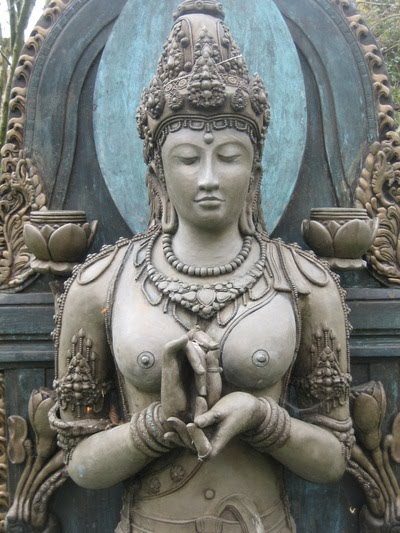
Over the next few days I searched though images and symbols on my bookshelves and on the internet.  The female buddha I've been wearing is the goddess Tara.  Tara is the mother of liberation, a bodhisattva, and in the Buddhist tradition, "Tara is actually much greater than a goddess -- she is a female Buddha, an enlightened one who has attained the highest wisdom, capability and compassion. . . one who can take human form and who remains in oneness with every living thing." [from: http://www.goddessgift.com/goddess-myths/goddess_tara_white.htm] 

As I told this story to my daughter, I remembered one of our favorite books, There Is a Flower at the Tip of My Nose Smelling Me by Alice Walker.  As it turned out, this entire time, there has been a goddess around my neck wearing me.

That's how it always is, I think.  Like in the famous poem, Footprints in the Sand by Mary Stevenson, we may not know it, we may be unconscious of it, but the goddess is always wearing us -- is always carrying us.  We are her, every bone in our body, every hair on our head, each flower, each tree, each beat of our heart, each breath -- all expressions of something sacred... all forms born from the creative energy of Mother Earth.  

I've taken this discovery back to my zafu and each morning I feel myself dissolving back into her.  She is Tara, she is Prithvi, she is Vajrayogini.  She's Mary and Artemis and Ostara too.  She is me and she is you.  She is our daughters and she is the very earth upon which we step.   

I'm still keeping my heart open to discovering an aspect of her to be my guide.  I don't want to be too hasty; although, Tara does seem like the obvious option.  More importantly, I'm remembering that to walk on the earth is to press our feet against the life-giving goddess herself.  This is why we must live skillfully and practice peace in every step.  All life is interdependent and flowing from the same source, rising and falling, constantly becoming.  Each of us is one element of a greater whole and beneath our stories and our habitual reactions exists a quiet observer dissolving back into the luminous nature of the One.

Thursday, July 1, 2010

Summer's Song

Outside the wildflowers of spring have dropped away into the golden hills of summer.  Leaves have grown full, gardens have grown abundant, and the busy-ness of spring has faded into summer's slow song.  American poet William Carlos Williams wrote, "In summer, the song sings itself."

The Summer Solstice came and went and now, after reaching her full strength, the sun is journeying away from us again.  Like the outside world, our inner world also moves in seasons rising and falling, growing and fading, always transforming and becoming.  This season of warmth and rest is a time for recognizing completions; for laying down what we've finished or what no longer serves us.  Here at Om School, we've said goodbye to Kindergarten and are relaxing into the next step of our journey.

We finished the year with Y for yogini and Z for Zigongosaurus, a genus of sauropod dinosaur from the Middle-Late Jurassic age of Zigong, China.  While the learning never stops, we've also laid down my formal lesson plans for summer and have been enjoying unstructured learning.  Our schedule includes a new adventure with our meditation center, Spirit Rock, where the children's sangha has just begun.  Last week, A. enjoyed making new friends in the K-6 class and I enjoyed the adult sitting group and Jack Kornfield's dharma talk,  Turning of the Seasons.

For our June mindfulness unit, Summer's Song, we relaxed into the turning of the seasons; listened to nature as she slowed down; and let go of things we'd completed.  As summer continues, we'll bring conscious attention to the smells and tastes that are so different now than the rest of the year.  We'll listen to the cicadas and notice how white clouds dot the bright blue sky.  We'll keep a science journal of native birds, read books, and make lemonade.  We'll watch the sun set and smile as she dips behind the mountain.  Most of all, we'll listen as summer sings her song.

What are you doing to connect with your kids this summer?  What are you doing to connect with nature?  I'd love to hear your plans and ideas...

Sunday, May 30, 2010

Wildflower Walk


"To see the fire that warms you or, better yet, to cut the wood that feeds the fire that warms you; to see the spring where the water bubbles up that slakes your thirst and to dip your pail into it; to see the beams that are the stay of your four walls and the timbers that uphold the roof that shelters you; to be in direct and personal contact with the sources of your material life; to find the universal elements enough; to find the air and the water exhilarating; to be refreshed by a morning walk or an evening saunter; to find a quest of wild berries more satisfying than a gift of tropical fruit; to be thrilled by the stars at night; to be elated over a bird's nest or a wild flower in spring - these are some of the rewards of the simple life." - John Burroughs (1837 - 1921)

Tuesday, May 18, 2010

W is for Water

The spring rain has given itself to our studies this week.  We're working on the letter W and looking deeply at water.  Yesterday we took a long walk in the rain and collected drops to add to a pretty bottle we're displaying on our nature table. 

Water moves in a great cycle, evaporating from the surface of the ocean, forming clouds and producing rain.  Our feelings are often represented by images of water.  We feel "bathed in love" and experience "waves of emotion."  Water rolls in waves and scientists were astounded when they discovered the wave–particle duality of matter.

Water represents seventy percent of the earth's surface and seventy percent of our physical bodies. Our life began in water... in the gentle rocking waves of our mother's womb -- and it is from water that the first life on earth emerged.  In the Tao Te Ching, we see water as a great teacher... “Nothing in the world is more flexible and yielding than water. Yet when it attacks the firm and the strong, none can withstand it, because they have no way to change it. So the flexible overcome the adamant, the yielding overcome the forceful. Everyone knows this, but no one can do it.” 

American author and poet Henry David Thoreau said, “Water is the only drink for a wise man."  Yet, despite water's essentially for survival, it has become the victim of indifference.  The average individual daily consumption of water in America is 159 gallons, while more than half the world's population lives on only 25 gallons.  Eighty percent of our water bottles end up in landfills - many of them in India - and every minute, one person in India dies of a water related disease. (from GOODMagazine.com) What's more, one sixth of the world's population does not have safe drinking water. (from: http://www.mindfully.org/Sustainability/Americans-Consume-24percent.htm).

What can we do?  We can talk to our children about water.  Their awareness is always the first seed of change.  We can also model healthy habits...

On a recent trip to Green Gulch Farm and Zen Center,a woman in the restroom caught my daughter's eye.  She was at the sink basin and, after wetting her hands, turned the faucet off to lather rather than letting it run.  Without a word, I watched my little one step up to the sink, turn on the water, wet her hands, and then turn it off again.  Our actions speak more loudly than our words and our kids are always watching.  

The next time it rains, try siting quietly with your child and listening.  Listen for the sounds of the drops on the roof, the rustling of the rain in the trees.  Sit and breathe and listen.  Then turn your palms upwards - as if the rain were falling gently into your hands.  Try sending your awareness down to the center of your hands and sensing your body from within.  Can you feel the gentle patter of the raindrops? 

We'll continue looking deeply at water throughout the week... thanking each drop that falls from the sky.  Then, this weekend, we're taking a mini-vacation to the ocean.  Standing in awe of the ocean's vastness is always a reminder that the water flowing on earth is the same water flowing in our own bodies. When we see that the four elements of the cosmos are the same elements in our body, we learn to honor both.

Sunday, April 18, 2010

Earth Day: Ten Small Changes

Earth Day is April 22nd.  This is a perfect time to talk to our kids about our connection to the earth and to tune up our daily living habits.  While crafts and games are fun expressions of our commitment to honoring the planet, it's real-life practices that actually make a difference... and even the smallest changes matter.  More than anything else, modeling eco-compassionate behavior teaches our kids to live consciously.  What follows are ten small, easy to accomplish practices that will continue to make a difference long after the Earth Day excitement has settled.

1.) Line Dry and Cold Wash.  Washing in cold water preserves your clothes, saves energy, and saves money.  Electric dryers emit approximately one ton of carbon dioxide per household per year and they are the second biggest energy suckers in American homes.  (http://www.linedryit.com/arbitrage/pages/Home) Want to jazz up your laundry?  Try these Set of Eight Music Note Clothespins from Etsy.

2.) Say no to dyes.  What goes on your body is as important as what goes into it.  Recent studies have linked artificial food dyes to cognitive impairments and behavior problems.  According to Helen Coronato, author of Eco-Friendly Families, the four most popular dyes are Red 3, Yellow 5, Yellow 6, and Blue 2.  Coronato suggests having a dangerous dye scavenger hunt.  Even if your kids are just learning to read, this is a fun way to enlist their help.  Make a list of these dyes and send your kids into the bathrooms and kitchen to gather lotions, toothpaste, shaving cream, breakfast cereal, mac and cheese, chips, and other packaged foods.  You'll be surprised at what is lurking in your home.


3.) Discover DEA.  While your kids are reading labels for dyes, you might want to check your personal-care product labels for Diethanolamine (DEA).  In his book, Green Made Easy: The Everyday Guide for Transitioning to a Green Lifestyle, Chris Prelitz explains that DEA is widely used in shampoos, creams, and lotions to thicken the consistency and can react with other ingredients to form a toxic carcinogen.  DEA cannot be purged from the body and builds up over time.

4.) Go herbal.  Forget what you've seen in television commercials, put down that can, and make your own bath and beauty products.  Common ingredients in store-bought hairsprays include carcinogenic PVP and formaldehyde.  Here's how to make your own: gently boil a few cups of rosemary sprigs and steep for 2-3 hours.  Strain and pour liquid into a spray bottle. Spritz for a light, eco-friendly hold. But don't stop there... Rather than supporting corporations selling dangerous products, make your own bath salts using this simple recipe: 3 cups Epsom salt, 1 cup baking soda, 1/2 cup sea salt.  Add fresh rosemary, lavender, or even olive oil.  For a body exfoliator that leaves your skin smooth and silky, mix olive oil with coarse raw sugar and smooth in a circular motion over skin.  Want to go really green?  Try growing your own herbs.   


5.) Join a CSA.  Community Supported Agriculture (CSA) means membership with a local, organic farm where you receive a weekly box of seasonal, organic, local produce.  The best organic food is what's grown closest to you because fewer fossil fuels are used to get it to your home.  The added treat we've discovered since making the switch is the connection to earth that comes from eating what's in season.  Seasonal cooking really does make every meal feel like a holiday.  Use Local Harvest (www.localharvest.org) to find farmers' markets, family farms, and other sources of sustainably grown food in your area, where you can buy produce, grass-fed meats, and many other goodies.  If you're in our neck of the woods, try Riverdog Farm.

6.)  Meat your meat.  The meat industry accounts for 70 percent of water pollution in the USA and studies show that going completely vegetarian has a more positive eco-effect than driving a hybrid car.  What's more, the use of antibiotics in livestock contributes to antibiotic resistance and the rise in "super-bugs." One of the best-known super-bugs, MRSA -- a kind of staph infection -- kills about 18,000 Americans annually.  That’s more than die of AIDS.  This doesn't mean that you have to go totally vegan.  Rather, we simply need to make smart choices.  Look for antibiotic-free eggs and meat at your local market or use Local Harvest to find a family farm that sells hormone-free and antibiotic-free grass-fed beef and free-range chicken.  If you're in our area, contact Gayle Pullman at Loconomi Farm.


7.) Choose Nature.  One more way to honor and celebrate Earth is by encouraging creative, nature-based play.  Instead of buying noisy toys that need batteries or electricity, let your kids hunt for supplies outside and build their own forts and playhouses.  One mama we know and love recently built a life-size tepee for her daughter in their garden using tree branches, ribbons, and beads.  Not creatively inclined?  Fairy houses like the one pictured here, Fairy House Retreat for a Weary Fairy, are always available on Etsy.  Another easy way to stimulate imaginative play and encourage innovation is with Play Silks ... and if there is one thing this planet needs now, it's innovative ideas to bring us into a greener tomorrow. Willow Tree Toys, Chinaberry.com, and Bella Luna Toys are wonderful online resources for natural toys and books that encourage kids to love Mother Earth.  

8.) Become PVC free.  Polyvinyl Chloride (PVC or vinyl), is used widespread in schools across the nation, threatening children’s health. The Center for Health, Environment & Justice is kicking off a brand new PVC-free schools campaign to encourage schools to ditch the poison plastic in favor of safer alternatives.  You can read more on their website and don't forget to do a complete sweep at home and make sure you are PVC free.  One way to be sure if the packaging of a product is made from PVC is to look for the number "3" or for the letter "V" inside or underneath the universal recycling symbol (the symbol used to designate recyclable materials. It is composed of three chasing arrows that form a Möbius strip or unending loop (http://en.wikipedia.org/wiki/Recycling_symbol)). This means that the product is made of PVC. Soft flexible plastic products that are made with PVC often have a distinct odor.

9.) Don't forget Mr. Whiskers.  Most of us love our pets just like members of our family.  Yet, most canned pet food available at supermarkets contains the lowest grade of meat possible, called "4-D," made from meat from animals which are dead, diseased, dying or have been destroyed.  Make a humane and healthy choice for your pets by purchasing organic food for them too.  Check out the All Natural Pet Food Directory for more information. 

10.) Green your consciousness.  The Benefits of Meditation are finally being recognized by the medical community.  This Earth Day, consider clearing out a corner of a room, transforming a nook in your yard, or converting your patio into a place of peace.  Avoid the temptation to use quiet time for making lists or checking email and for a few designated minutes each day, try sitting with nothing but your breath.  When your mind turns back to usual worries, plans, or concerns, just say, "not breath," and go back to a place of quiet focus.  For audio instructions on both sitting and walking meditation, check out the Insight Meditation Center's Meditation Instructions.

Going green shouldn't cost anything, it shouldn't make us worry, and it shouldn't end when the buzz of Earth Day subsides.  Rather, making eco-compassionate choices should feel good because at our deepest level, we are all connected.  What's more, when we live consciously, we demonstrate to our kids our commitment to honor one another and to honor and preserve our planet.

At the deepest level of ecological awareness you are talking about
spiritual awareness. Spiritual awareness is an understanding
of being imbedded in a larger whole, a cosmic whole,
of belonging to the universe.

- 
Fritjof Capra

Friday, April 9, 2010

Kindergarten Ecology

We are on spring vacation... so our lessons have been informal, our goals have been to relax and restore, and our days have been full of sunlight and friendship.  

Learning comes in infinite forms... and breaks from our regular schedule always remind me that, even without formal schooling, kids are always learning.  Sometimes, it's the lessons we don't plan for that have the most meaning.

In other words, Om School never really takes a break.  When your heart's compass is set strongly towards the ocean, everything you do, intended or not, flows down that river.  Something I desire deeply for my girl is for her to feel her connection with the earth, to know that she is connected to every other living thing, and to see that each drop of dew, every blade of grass, and all the creatures who walk upon it are sacred.  I think that the deepest peace a human heart can feel comes from loving and being loved in return.  Learning to feel to feel love from the natural world might just ensure that that deep peace.  It's there, always loving us, always providing for us... no matter what -- every day the sun shines down on us and the earth beams back.  We stand in the middle often too asleep to know that we are being held in that embrace.


When we awaken to this love, to our hidden connections with all things, we realize that it is up to us to care for the earth as we care for our children, our closest friends, and our families.  The earth truly is our mother and we should cherish her -- not just so we can use up her resources at some later date in time -- but because she is sacred.  

With Earth Day coming up on April 22nd (and turning forty this year) it's a perfect time to turn our attention to the environment.  I'm working to develop a thematic unit on ecology and will post resources here as I find them.  A great starter reading list can be found here: Children's Nature & Ecology Books and Elementary Education Resources: Kindergarten is a great site for developing your own lesson plans, games, and activities to get your kids involved and caring about the environment.  

Still, I think stories and picture books speak to a young child's heart more than scientific information... and I've been meaning to get this book for months now:  The Last Wild Witch by Starhawk.  You can support an independent book store by purchasing it at 100Fires.com: Extraordinary Books (and More!) for a Healthy Planet.  

This PDF, "The Last Wild Witch Teaching and Discussion Guide", is a fantastic guide -- full with discussion questions, language skill-builders, art projects, music circles, and science projects.   

The following video, a promo for the book, is a treasure by itself and a lesson in global responsibility.  Listen for the last lines, as the children realize, "Maybe we're supposed to do something... Maybe we're supposed to save the forest..."

Deep peace to all.


Related Posts with Thumbnails