Showing posts with label zen. Show all posts

Thursday, July 28, 2011

Ocean Sunset


"Creation is only the projection into form of that which already exists." - The Bhagavad Gita

Saturday, August 21, 2010

Day Two: Meditation Challenge {five tips for supporting your practice}

Because everything is connected, everything we do off of the pillow effects what happens on the pillow.  Here are five tips for supporting your practice.

1.) Create an environment of calm.  De-clutter the counter-tops, tidy your bookshelves, and organize your closet.  Encourage your kids to play with only one toy at a time.  Unplug the television.  Resist the urge to check emails and social networks first thing in the morning.  Consider these two weeks an at-home meditation retreat.

2.) Enlist support.  Tell friends and family about your meditation challenge.  Ask them to support you by contributing to your environment of calm. 

3.) Eat mindfully.  Enjoy whole foods, raw fruits and veggies, and organic grains.  While you are cooking, consider the long journey your food made to get to your kitchen.  Set the table with cloth napkins and tablecloths.  Consider saying a verse before eating such as, "the meal on my plate is the work of the universe."  Chew only your food - not your ideas or projects or worries.

4.) Exercise.  When our body is restless, so is our mind.  Try starting your day with a few rounds of Sun Salutations.    Get to a class, go for a walk, or exercise right at home with one of these award winning yoga DVDs from Gaiam.

5.) Connect with nature.  Noticing what is happening outside helps us notice what is happening within.  Watch the sunrise or the sunset.  Walk barefoot on the grass.  Have a picnic lunch.  Get to know the native plants in your area.  Create a nature table with seasonal items found on walks.   

It's not too late to join our 14 Day Meditation Challenge.  Sign up here and let your fourteen days begin today.  Much love & light to all.

Thursday, August 19, 2010

Retreat Within: 14 Day Meditation Challenge

The Inn at Schoolhouse Creek, Mendocino, CA

A few weeks ago, I had the honor of retreating with some lovely mamas to the Mendocino Coast.  This was this first in what we hope to be an annual woman's retreat.  

I came home feeling rejuvenated, relaxed, and renewed.  In the weeks that followed, I was inspired to get back into my yoga practice, succeed at a seven day raw-food cleanse, and re-commit to my meditation practice.

Most of all, I was able to carry the balance I re-claimed at our retreat into my daily life.  While I wish I could live by the sand, sea and botanical gardens, I realize that these things are just a backdrop.  The scenery that truly matters is within our own minds. Retreats and spiritual pilgrimages (think Eat, Pray, Love) are wonderful ways to connect with ourselves; however, tending to our inner-garden is something that we can do everyday -- right here at home.  

Mendocino Coast Botanical Gardens


In her poem, Risk, Anaïs Nin writes, "And then the day came, when the risk to remain tight in a bud was more painful than the risk it took to Blossom."  I think starting a meditation practice is a lot like this.  Each moment is a new chance to blossom.

It's been twenty-six days since I re-committed to my meditation practice. Two more weeks will make it forty days (an important number for Buddhists and Christians).  I've been sitting for at least thirty minutes every morning and haven't missed a day.  I feel grounded and balanced and grateful for the mamas who helped me get back to this place.  What's more, I've rediscovered that  "retreat" is a state of mind.  Each time we sit on our pillow, each time we connect with our breath, and each time we pause before we react, we take a little spiritual retreat -- we give ourselves a chance to rejuvenate and renew.

I'd like to invite you to join me on my home stretch to forty days by making a pledge to sit for the next fourteen days.  In the days that follow, I'll post instructions, tips, links, and other goodies to help you get started with a sitting practice.  

Please leave a comment here or send me an email at mettamama [at] yahoo [dot] com if you'd like to join the challenge.

[photo credits: Heather Sewell Rush & Karyl Averill]

Tuesday, August 17, 2010

Morning Ritual: Five Yogic Habits for a Stress-Free Day

Sleepy Kid in the Morning Sunbeams
I am a big advocate of peaceful mornings.  When we start our day with peace, we create an opportunity for a stress-free day.  Here are five yogic habits that might just help you create a peaceful morning rhythm.  

1.)  Rise and shine.  Begin your day with the cool earth-energy that lingers before daybreak. Savor this stillness.  Prepare to be happy and shine.

2.)  Take it slow. Instead of hitting the floor running, take a few minutes to wake up.  Sit up, take a few deep breaths, and set an intention for a peaceful day.  Consider saying a verse like this ancient Indian mantra: "On the tip of my fingers is prosperity and abundance (goddess Lakshmi); in the middle of my hand is eloquence and learning (goddess Saraswati); at the base of my hand is divine power (goddess Gauri).  In the morning, a vision of energy in my hands." 

3.)  Cleanse.  Instead of racing (or schlepping) out to the coffee maker, consider the advice of ancient yogis, step into the bathroom, and say goodbye to yesterday.  Empty your bowels, brush, floss, and scrape that fuzzy tongue.  Ayurveda interprets tongue-fuzz as a sign of undigested toxins lurking in the digestive tract.  Unless we scrape, it's reabsorbed while eating or drinking.  Next, it's time for a cool shower.  Too much steam makes us sleepy -- a cool shower wakes up the body.

4.) Meditate.  Oodles of evidence now exists in support of the benefits of meditation.  Some of the health benefits include stress reduction, better sleep, lower blood pressure, an increased sense of well-being, and increased neuroplasticity.  To begin, borrow a pillow from your couch, put your tush on the cushion, and breathe.  It's that simple.  Just sit for a few minutes each morning and focus on your breath instead of your thoughts.  For instruction on mindfulness meditation, click here.  For instruction on Zen practice, click here.

5.) Step Outside.  Take a few minutes each morning to connect with nature.  Step into your garden or onto your patio and absorb some of the cool, new day.  Stand in Mountain Pose for a few minutes with your feet rooting down into the earth.  Notice the color of the sunlight and the sensation of morning air in your lungs.  Feel the freshness of the hour.  Instead of plopping them in front of the tube, invite your kids to join you outside.  Take just one breath together, smile, then quietly say, “Good morning, world!” Take this stillness into your day.

A few small changes in your routine might just make a big difference.  Beginning your day with peace in your heart is certainly a step in the right direction.  As Patanjali, compiler of the Yoga Sutras, writes, “Peace can be reached through meditation on the knowledge which dreams give.  Peace can also be reached through concentration upon that which is dearest to the heart.”

Tuesday, August 10, 2010

A Wise Heart

We've been infusing our studies with the dharma since preschool.  Along with trips to Green Gulch Farm Zen Center and Spirit Rock Meditation Center we incorporate gathas, mantras, mindfulness exercises, the Eightfold path, the Brahma Viharas, and the Pāramitās into our studies.  We've worked out a pretty elaborate system over the years and it's been a real joy.  A. will be six on Thursday and she seems to truly enjoy this aspect of our home studies.  

At present, I'm writing a curriculum (based on our home studies) that follows the changing seasons and invites parents to engage in their child's inner-world.  Each month, we look at a virtue (compassion, loving-kindness, joy in others, equanimity, patience, generosity, wisdom, etc) and explore how nature is the best teacher.  I thought I'd share a bit of our routine here for all of you who are considering homeschooling or wondering how to incorporate your spiritual path into your daily schedule.

We start each day by lighting a candle and making an offering of incense in the kitchen. Then we listen to mantras and cook together.  A. sets the table and we eat quietly to set a focused tone for the school-day.  She either draws or plays while I clean up -- but not with anything noisy, digital, or electric.  I encourage stillness in the morning and have found that the less riled up she is before we start our day, the better.

Next it's Circle Time.  We sit on our zafus facing one another in the classroom and start our day with this gatha:

We are the leaves of one tree
We are the waves of one sea
The time has come for us to live as one

After the morning verse, I say a cheery little prayer such as, "Mother Nature, Universe, gods and goddesses, buddhas and bodhisatvas, ancestors, and fairies -- we're calling on all of the energies of the earth to be present in our classroom today... help our hearts grow wise so that we may know peace within and create peace here on the earth.  Blessed be, so be it, and let it be so!"

Then I say, "let us enjoy breathing together," ring our little gong, and we sit for a few breaths to focus and really arrive in the classroom.  I encourage A. to listen to all of the sounds, feel her breath in her nostrils, and notice all of her feelings.   Sometimes we'll lay on our backs with stones on our bellies and watch the stones rise and fall with our breath.  Other mornings, I ask her to listen to the gong and raise her hand when the sound has completely vanished.

Next, I invite A. to go to her "Creative Infinity"  -- the creative center of our being where the universe comes from.  Here, we look for a virtue in the form of an animal totem to "bring back" to the classroom and keep with us all day.  Some of A.'s favorites are the Cheetah of Loving-kindness and the Deer of Compassion.

After Creative Infinity comes Sharing Time.  We pass a basket of sticks and stones between us - each selecting one as a "talking stick" or a "stillness stone."  I invite A. to share anything she wants -- a difficult feeling, a story, or a favorite toy.  I usually share the calender and then use the rest of my share to introduce, review, or expand on a dharma or mindfulness unit.

Then it's time for the Main Lesson.  For Kindergarten we alternated between Language Arts and Math and I usually used an archetypal story to introduce new letters, words, phonics, numbers, or math concepts (i.e. King Plus and Queen Minus).  After drawing the story in her Main Lesson Book, singing the spelling of new words, or marching out the math facts, it's time for a little movement.

One of our favorites is a chant that we've added asanas (yoga poses) to:

Earth my body (mountain pose)
Water my blood (five pointed star pose)
Air my breath (standing prayer/pranam)
And fire my spirit (clap hands and wave them above your head)

Then it's lunch time.  While I prepare our food, she has playtime inside.  We usually set the table and recently started a new ritual of setting our food down by the kitchen alter for blessings before we eat (that's Saraswati, the goddess of creativity and learning, in the picture frame).  

Here's a great little gatha to make lunch more mindful:

Earth who gives to us this food
Sun who makes it ripe and good
Dear Earth, dear Sun
By you we live,
Our loving thanks
To you we give.

After lunch it's outside time.  I try to incorporate some Earth Science into our outside time but sometimes A. just plays.  After an hour or so, it's back in for an afternoon lesson.  I use this time for art, music, dance, yoga, science, or social studies. We alternate through these subjects throughout the week and I'm always amazed at how they integrate so naturally with the morning lesson.

We end each school day with a verse that I found in the Oak Meadow Kindergarten Syllabus.  I've expanded it and added yoga poses:

I can be as small as a small, small seed (child's pose)
I can be as tall as a tall, tall tree (tree pose)
As strong as a mountain (mountain pose)
As brave as can be (warrior III)
Because I'm a Goddess (goddess pose)
Can't you see!

One of the greatest things about educating at home is making it personal.  Incorporating our spiritual path into our studies with gathas, mantras, and mindfulness exercises has helped us strengthen our connection with one another (and with the earth) and deepened our awareness about the larger context from which our lives emerge.  What's more, this holistic method of incorporating core subjects with our spiritual path sets a framework for keeping our minds and hearts integrated.  I believe this is a path to cultivating more than intellect... it is a path to a wise heart.  

Sunday, August 8, 2010

Finding the Feminine

I was chatting with a dear friend recently, when she mentioned something about her personal deity, Artemis.  We follow similar paths and see the earth herself as a living, sacred, manifestation; however, I'm more of a pantheist and she's more of a polytheist.  We don't squabble over the details though.  Instead we embrace what we share.

I had all but forgotten that she had a personal deity and my initial reaction was something like a five year old in a toy store, "I want a personal deity too!"

She went on to tell me about the process of discovering the goddess who would be her guide and the gratitude she holds in her heart now that she's found her.  In the days that followed, I decided to keep my heart open to the notion of discovering my own personal deity.  What mama doesn't need a little guidance from the divine feminine?  

To me, gods and goddesses are states of consciousness that we are all capable of becoming.  They are archetypes telling the story of the cosmic drama that plays out in our lives again and again.  They exist within us and beyond us as energies upon which we can call to be present in our hearts, in our minds, and in our lives.  They are sacred because there is nothing that is not sacred.  Every element of nature, every vibration, every thought is sacred.  Every beam of sun and each blade of grass is a sacred manifestation. 

In the days that followed our conversation, I kept my eyes open for signs of goddesses making themselves known to me.  I opened this month's Yoga Journal and found a mantra to the goddess of abundance and prosperity, Lakshmi.  Lakshmi is one of my favorite Vedic goddesses and I've actually been using her mantra all year.  Could she be my personal deity?  No, I don't think so... but I'm still calling on her just the same.

Then I thought of an article, Mothers of Liberation, that I'd recently found at Tricycle.  Here, Miranda Shaw explores "some of the many powers, symbols, and stories of the often overlooked and misunderstood [Buddhist] pantheon."  I discovered Vasudhara, Hariti, and Vajrayogini -- a divine yogini, compassionate, all-knowing, and supremely blissful. 


Could Vajrayogini be my personal deity?  Maybe.  She's my kind of goddess.  Still, I decided to keep my heart and mind open to the process.  I remembered Prajnaparamita, the Buddhist Sophia and compassionate mother of bodhi.  I remembered Prithvi, the Earth Goddess who rose up to witness Buddha attaining enlightenment under the bodhi tree.  Could Prithvi be my personal deity?  I love this idea because nature is the teacher I look to most. 

Later that night, I found myself on Etsy searching handmade items with the keyword, "goddess."  Amongst other pretty things, a silver necklace jumped out at me.  Taking a closer look, I realized it is an exact replica of the necklace I wear nearly every day -- a gift from my mother-in-law who described it as a Buddha.  Yet here, in an extreme close up view, I saw something that could mean only one thing -- breasts!  The necklace I've been wearing is not the Buddha... it is a buddha -- and a female buddha at that!

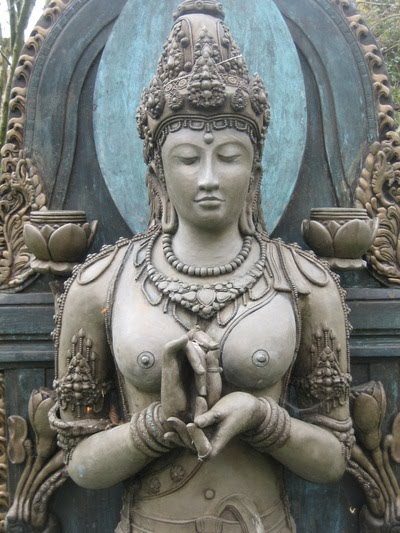
Over the next few days I searched though images and symbols on my bookshelves and on the internet.  The female buddha I've been wearing is the goddess Tara.  Tara is the mother of liberation, a bodhisattva, and in the Buddhist tradition, "Tara is actually much greater than a goddess -- she is a female Buddha, an enlightened one who has attained the highest wisdom, capability and compassion. . . one who can take human form and who remains in oneness with every living thing." [from: http://www.goddessgift.com/goddess-myths/goddess_tara_white.htm] 

As I told this story to my daughter, I remembered one of our favorite books, There Is a Flower at the Tip of My Nose Smelling Me by Alice Walker.  As it turned out, this entire time, there has been a goddess around my neck wearing me.

That's how it always is, I think.  Like in the famous poem, Footprints in the Sand by Mary Stevenson, we may not know it, we may be unconscious of it, but the goddess is always wearing us -- is always carrying us.  We are her, every bone in our body, every hair on our head, each flower, each tree, each beat of our heart, each breath -- all expressions of something sacred... all forms born from the creative energy of Mother Earth.  

I've taken this discovery back to my zafu and each morning I feel myself dissolving back into her.  She is Tara, she is Prithvi, she is Vajrayogini.  She's Mary and Artemis and Ostara too.  She is me and she is you.  She is our daughters and she is the very earth upon which we step.   

I'm still keeping my heart open to discovering an aspect of her to be my guide.  I don't want to be too hasty; although, Tara does seem like the obvious option.  More importantly, I'm remembering that to walk on the earth is to press our feet against the life-giving goddess herself.  This is why we must live skillfully and practice peace in every step.  All life is interdependent and flowing from the same source, rising and falling, constantly becoming.  Each of us is one element of a greater whole and beneath our stories and our habitual reactions exists a quiet observer dissolving back into the luminous nature of the One.

Thursday, July 1, 2010

Summer's Song

Outside the wildflowers of spring have dropped away into the golden hills of summer.  Leaves have grown full, gardens have grown abundant, and the busy-ness of spring has faded into summer's slow song.  American poet William Carlos Williams wrote, "In summer, the song sings itself."

The Summer Solstice came and went and now, after reaching her full strength, the sun is journeying away from us again.  Like the outside world, our inner world also moves in seasons rising and falling, growing and fading, always transforming and becoming.  This season of warmth and rest is a time for recognizing completions; for laying down what we've finished or what no longer serves us.  Here at Om School, we've said goodbye to Kindergarten and are relaxing into the next step of our journey.

We finished the year with Y for yogini and Z for Zigongosaurus, a genus of sauropod dinosaur from the Middle-Late Jurassic age of Zigong, China.  While the learning never stops, we've also laid down my formal lesson plans for summer and have been enjoying unstructured learning.  Our schedule includes a new adventure with our meditation center, Spirit Rock, where the children's sangha has just begun.  Last week, A. enjoyed making new friends in the K-6 class and I enjoyed the adult sitting group and Jack Kornfield's dharma talk,  Turning of the Seasons.

For our June mindfulness unit, Summer's Song, we relaxed into the turning of the seasons; listened to nature as she slowed down; and let go of things we'd completed.  As summer continues, we'll bring conscious attention to the smells and tastes that are so different now than the rest of the year.  We'll listen to the cicadas and notice how white clouds dot the bright blue sky.  We'll keep a science journal of native birds, read books, and make lemonade.  We'll watch the sun set and smile as she dips behind the mountain.  Most of all, we'll listen as summer sings her song.

What are you doing to connect with your kids this summer?  What are you doing to connect with nature?  I'd love to hear your plans and ideas...

Tuesday, June 1, 2010

Wisdom Teachings in the Internet Age


The first ever Wisdom 2.0 conference, held April 30th-May 2nd in Silicon Valley, brought together staff from Google, Twitter, Facebook and other technology companies, along with Zen teachers and neuroscientists to explore living with wisdom in our technology age.
The list of speakers is here.  Be sure to sign up for their e-newsletter, join their Facebook page, or follow them on Twitter to learn about more Wisdom 2.0 events.

In this thought provoking panel discussion, Malika Chopra (Intent.com), Alana Kornfeld (Huffington Post Living), Susan Kaiser Greenland (The Mindful Child and Mindfulness Together), Mary Ann Brusset (Spirituality & Practice.com), and moderator by Tami Simon (Sounds True) discuss how can we use the tools that are now available to us in the twenty-first century for maximum raising of consciousness and responsible dissemination of the wisdom teachings.

It's well worth the hour to watch through the end where the panel discusses the challenges and opportunities that online communities face in creating meaningful experiences and how the wisdom and light discovered online might translate into our three-dimensional lives.

Sunday, April 25, 2010

The Earth in Us

Our Earth Week began with a day-trip to the ocean on the Thursday before Earth Day.  In the days prior, my morning meditation had been infused with a new sense of devotion, of love for the feminine, life giving, creative energies of Earth.  At the same time, a dear friend from out-of-state came for a visit, and we met at The Ren Brown Collection Gallery in Bodega Bay for Mayumi Oda's Feminine Buddhas exhibit.  It wasn't until we returned home that night that I realized the Sanskrit word for goddess is "devi" and it was probably no coincidence that I'd been feeling an opening in my heart, a sense of dev-otion to the feminine, leading up to our trip to the ocean.  

Friday was a beautiful morning so we hopped in the golf cart and headed out for breakfast.  Along the way, we noticed that the water at the lake was perfectly still; bright and blue glowing glass.  We pulled into the marina to watch the sky reflecting on the water.  Just then, six goslings came waddling to the edge of the lake with mama and papa close by their sides.

The morning was so still, so calm, that we came back and enjoyed breakfast picnic-style by the water.  By then the goslings had gone so we set up camp at a nearby lakeside park.  After breakfast, it was time for a little yoga with a sequence we call Earth-Body link.  The sun moved overhead and the morning gave way to afternoon.  It was time to hit the books.  We cruised back home but it was too late.  We'd been bit by the outside bug.  


"Mama, I want to go back to Little Beach."


I couldn't have agreed more.  So we packed up our school supplies and went back to the little lakeside park.  This was the beginning of a new Om School tradition that we're keeping alive: Outdoor Fridays.  

On Sunday, we continued our Earth Week with family a trip to the walking trails and botanical gardens at Skyline Wilderness Park.  After a little picnic lunch, we enjoyed learning about the trees and wildflowers native to our area.  Skyline is an amazing park with picnic grounds, a disc golf course, an archery range, a social center, tent, RV and horse camping, a barn and arena for equestrian use and, of course, the amazing native plant garden filled with beautiful old trees, redwoods, cottonwoods, oaks, and flowering jewels like wild lilac and dogwood.  Our favorite is a two-hundred year old Valley Oak... in her presence, time slows down and all worries fade.

Monday, we took school outside again for some sacred garden time and began our studies with Chapter 39, Protecting the Earth, from my favorite book, Thich Nhat Hanh's, Touching the Earth.  Here, the Zen Master asks us to let the mountains and the rivers be our witness as we promise to protect the earth and "transform garbage into flowers" and produce the energy of understanding and love.  We also read chapter 21, Earth, from Starhawk's, Circle Round and learned abot Gaia, the ancient Greek goddess whose name means, "Earth" and discussed the interdependence of all life.  Next, it was time for more traditional academics including writing complete sentences using proper punctuation and spelling.  Then, A. asked if we could hike around the land near our house pick up garbage.  It seems that all of our dirt loving and goddess worshiping is paying off! 

Tuesday the rain came and we stayed inside for our studies.  We put our new words on the board (up, us, under, until, upon, use, umbrella, unicorn, and unite), learned about the prefix "uni," and read chapter 39, Oneness with the Earth, from Thich Nhat Hanh's Touching the Earth in which Thay says, "I see everywhere the four elements of earth, water, fire, and air, and how they interrelate with everything and inter-are in me.  I shall touch the earth and remain close to the earth to see that I am one with Mother Earth; I am one with the sunlight, the rivers, the lakes, the ocean, and the clouds in the sky."  We also read "Growing: a Story" by Diane Baker and followed the life of a tomato seed from planting to blooming to becoming a living part of a little girl's body.

On Wednesday, we enjoyed a little extra mindfulness practice in our morning circle and sat, eyes closed, listening for outside sounds.  We heard the wind, the leaves in the trees, and a number of different birds.  Then, with our minds focused and still, we hit the books and the piano.  A. learned to play a new song (a difficult one with alternating hands and both melodic and harmonic intervals).  She read, The Maple Tree -- a story from the Oak Meadow Kindergarten syllabus (intended for the parent to read the child!), finished two new math worksheets with sums through 18 and rounding numbers to the nearest hundred, and made a pretty little Earth Collage.  

Later we read chapter 41 from Touching the Earth, The Earth as a Solid Place of Refuge and learned the story of Buddha facing the Mara under the Bodhi tree.  As Buddha sat in meditation reaching enlightenment, Mara appears as a demon and tells Buddha that he is declaring enlightenment for himself and earth as his realm. He points to his legions saying, "What I say is true. These are my witnesses. Who will believe that you speak the truth? Who will be your witness?" Undisturbed in his meditation, Buddha reached down and touched the earth.  I love this story and think it is a beautiful illustration of taking refuge in the earth -- and of earth as a place of solidity and acceptance.

Thursday was Earth Day proper and, after making offerings of wildflowers and seashells from our beach day to the earth goddess  Gaia, we rallied the local troops for a clean-up day at the creek.  Seeing these little smiling faces engaged in service made my heart sing.  When we get our kids involved young, they learn that honoring the earth is as essential as brushing their teeth.  (Ignore either and they'll go away.)  After the work was done, the kids splashed around a bit and we released rosemary, with wishes for the earth, downstream.  

Rosemary is the herb of remembrance, birth, and rebirth.  The name rosemary, which comes from the Latin, meaning "dew of the sea," hails back to its ancient origins. For centuries, it has been a symbol of friendship and hundreds of years ago it was dipped in gold, tied with a ribbon, and given as a keepsake at weddings. (from: http://www.sallybernstein.com/food/columns/gilbert/parsley_sage.htm)   I hope the kids will remember this loving gesture.  We are the newcomers to this community and I feel honored that such wonderful mamas have welcomed us into their fold and shared this special day with us. 

On Friday, we came full circle -- back to our little lakeside spot for a spelling test and a math test.  A. spelled all of her words correctly and has learned a number of little tricks and clues for remembering math facts.  We read, The Magical Seed by Lawrence Williams from the Oak Meadow Kindergarten syllabus.  This is a sweet short story that illustrates the cyclical journey of a seed, from earth to apple tree, and back to earth again... the same journey each of us makes in our lifetime.  

The great Zen Master Dogen wrote, "The whole moon and the entire sky are reflected in one dewdrop on the grass."  They're also reflected in the still morning waters of lakes and streams and in the wide, bright eyes of our children.  When we see that the four elements of the cosmos are the same elements in our body, we learn to honor both.  

By taking time to notice the little things, to see the hidden connections, to see the whole earth and the entire cosmos in ourselves, we create space in our heart for devotion... for real reverence for this beautiful blue and green earth that is our mother and our home... that is the one thing we all have in common.  By connecting with the earth, we see where we come from and to where we are going.  By touching the earth, we can release our fears and worries, take refuge in her solidity, and discover a lightness of our spirit that affords real freedom.  

Deep peace to all.

Thursday, February 25, 2010

Fairy Eyes, Beginner's Mind

It started on Sunday with a dear friend and an afternoon walk.  The girls wanted to wear fairy wings, so with their wands in the air, we set out in search of bits, bobs, and lost things to use for building a fairy garden.

The lot next door to our house is empty but for trees, rocks, and wild grasses.  To one set of eyes, a vacant lot is just empty space.  To another, it's a wonderland of secret treasures.  Having kids helps us keep our fairy eyes open... it's that ability to see things with a beginner's mind, with "an attitude of openness, eagerness, and lack of preconception," that creates opportunities for learning, growth, and self-awareness.  This is one of the guiding principals of our at-home education:  beginner's mind.

Shunryu Suzuki's book Zen Mind, Beginner's Mind, reflects a saying of his regarding the way to approach Zen practice: "In the beginner's mind there are many possibilities, in the expert's mind there are few."  I think this is the best way to approach just about everything.  When our ideas are already formed, there's no room for anything new... no room for anything magical or full of wonder.

In a wonderful lecture, Beginner's Mind, Abbess Zenkei Blanche Hartman defines beginner's mind as, "...the mind that is innocent of preconceptions and expectations, judgments and prejudices. Beginner's mind is just present to explore and observe and see "things as-it-is." I think of beginner's mind as the mind that faces life like a small child, full of curiosity and wonder and amazement. "I wonder what this is? I wonder what that is? I wonder what this means?" Without approaching things with a fixed point of view or a prior judgment, just asking "what is it?"  

Our world is one where knowing things is held in the highest regard.  Our schools function to test and measure minds and our children are pushed to memorize and repeat facts.  But what about preserving their ability to see things as they are?  What about nurturing their ability to build on ideas of their own?  Isn't this just as valuable (or maybe even more valuable) than the ability to remember things?

I think a child's mind is more than a bowl to fill... more than a receptacle for the things our society deems important.  If we spend all of our days filling up their heads with ideas, then what happens to the ideas of their own?  Equally important to learning about the world from a teacher's or an adult's perspective is seeing the world from a child's eyes.  

We filled a basket with treasures and have been working on our fairy garden all week.  We're practicing wearing our fairy eyes and seeing things just as they are, without prior judgment.  

With practice, we begin to see other aspects of our lives with this mind.  We lose our prejudices and notice that the world is full of wonder and magic.  It's here, in this spacious awareness, that we become free.
Related Posts with Thumbnails